Germanium Lens Manufacturer in China: How to Source High-Quality LWIR Optics Without the Premium Price Tag
If you've been pricing germanium lenses for LWIR thermal cameras, you've noticed something striking: a China-manufactured germanium lens with identical specifications often costs 40–60% less than its European or American counterpart. But lower price doesn't automatically mean lower cost at your end — it can also mean hidden quality risks that surface only after integration and field deployment.
So how do you separate the reliable germanium lens manufacturers in China from the commodity brokers? This guide walks you through what germanium lens manufacturing actually involves, what quality signals matter, and exactly what to verify before placing an order.
Why Germanium Is the Preferred LWIR Lens Material
Germanium (Ge) is the dominant material for LWIR (8–12µm or 8–14µm) thermal imaging lenses — and for good reasons:
The tradeoff: germanium is expensive (raw Ge material costs fluctuate with semiconductor demand), requires diamond turning or grinding-and-polishing for optical surfaces, and needs high-quality AR coatings to reach full transmission potential.
China's edge in germanium lens manufacturing comes from three converging advantages: access to domestic germanium feedstock (China produces a significant share of global germanium), large-scale diamond-turning CNC infrastructure, and lower labor and overhead costs that don't compromise optical precision.
What Separates Premium Germanium Lens Manufacturers from Commodity Sellers
Not all "Germanium lens manufacturers in China" are equal. The difference between a precision optics supplier and a low-cost broker is visible in the details.
Surface Quality & Finish
Surface quality is measured by the Scratch-Dig standard (e.g., 80/50, 60/40, 40/20 — the first number is scratch width in microns, the second is dig diameter in hundred-microns). For LWIR thermal imaging:
| Surface Quality Grade | Typical Use | Scratch-Dig Standard |
|---|---|---|
| Commercial | Cost-sensitive, large-format lenses | 80/50 to 60/40 |
| Precision | Standard industrial/security thermal cameras | 60/40 to 40/20 |
| High-Performance | Defense, long-range surveillance, automotive | 40/20 or better |
Many commodity suppliers advertise "40/20" surface quality but ship material with inconsistency across batches. Premium manufacturers provide interferometric surface maps with every batch.
AR Coating Performance
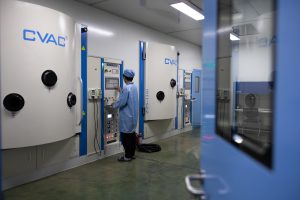
Without anti-reflective coating, a bare germanium surface reflects ~36% of incident LWIR radiation at each air-glass interface (due to germanium's high refractive index). Quality AR coatings push transmission to >95% per surface in the design band.
What to ask your manufacturer:
Centering & Axis Tolerance
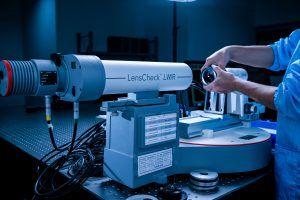
For LWIR lenses with germanium elements, optical centering (how precisely elements are aligned to the mechanical axis) directly affects image symmetry and distortion. Commercial-grade centering: ≤5 arcminutes. Precision grade: ≤2 arcminutes. High-end: ≤1 arcminute.
Temperature Stability / Athermalization
Germanium's refractive index changes with temperature (dn/dT ≈ 0.000396/°C), which causes focus shift in uncompensated lenses. For outdoor or automotive applications operating across -40°C to +60°C, look for:
Key Chinese Manufacturing Regions for Germanium LWIR Lenses
| Region | Specialty | Known For |
|---|---|---|
| Nanjing, Jiangsu | Highest concentration of IR optics firms | Uncooled LWIR lenses, germanium domes, automotive thermal modules |
| Shanghai | Precision optics, defense-grade | Diamond-turned germanium, aspheric LWIR lenses |
| Kunming, Yunnan | Precision optics manufacturing | High-volume production, quality consistency |
| Chengdu, Sichuan | Military & aerospace IR optics | MWIR/LWIR lenses for defense applications |
How to Verify a Germanium Lens Manufacturer's Quality
Documentation Checklist
Before ordering, request:
Red Flags
| Red Flag | What It Signals |
|---|---|
| No surface test reports available | Inconsistent or unverified quality |
| AR coating specs vague ("good transmission") | Likely low-quality coating, not production-verified |
| Extremely low price (30%+ below market) | Germanium raw material cost alone sets a price floor — something is being cut |
| No environmental testing data | Lens may fail in field conditions |
| Cannot specify BFL tolerance <±0.1mm | Uncertain optical alignment |
| Only sells "stock" lenses, no custom capability | Limited design engineering support |
Why We Are Your Ideal Germanium Lens Partner
We, we operate precision germanium lens manufacturing in Kunming, Yunnan Province — one of China's key centers for infrared optical research and production. Our germanium lens capabilities:
We work directly with thermal camera brands, security system integrators, and automotive Tier 2 suppliers worldwide — and we provide the full documentation package (material certs, surface reports, BFL data, coating curves) that quality-conscious procurement teams require.
Sample RFQ Template for Germanium LWIR Lenses
When requesting quotes, include this minimum specification:
Product: Germanium LWIR Lens
Focal Length: _ mm
F-number: F/_
Detector Format: × pixels
Pixel Pitch: _ µm
Spectral Band: 8-__ µm
Mount Thread: M_×0.75 (or specify)
Back Focal Length:  mm ±  mm
Operating Temperature: -°C to +°C
Surface Quality: Scratch-Dig /
AR Coating: 8-12µm dual-band, >95% transmission per surface
Quantity (Initial / Annual):  units /  units
Quality Standard Required: [Commercial / Precision / AEC-Q_]
Ready to source? Contact our export team with your specifications and we'll respond with a detailed quote and sample availability within 1 business day.
Related reading
- MWIR Lens for Gas Leak Detection: A Complete Guide for OGI System Integrators
- Germanium Window Engineering Guide: LWIR 8-14μm Optical Material Selection for Industrial Thermal Imaging
Have a technical inquiry?
Our sales team responds within 24 hours with specifications, pricing, and technical consultation.
CONTACT US →