Selecting the wrong infrared lens can cost more than the lens itself — it can derail an entire ADAS program, delay a security system deployment, or result in a production line shutdown. Yet infrared lens selection is often treated as an afterthought in system design, leading to costly redesigns late in the development cycle.
This guide covers the five parameters that experienced IR lens buyers and engineers verify before committing to a supplier — and what to ask when reviewing specifications.
1. Focal Length: Detection Range vs. Field of View
Focal length is the primary determinant of your system's effective detection range and field of view (FOV). The relationship is direct: longer focal length means narrower FOV but greater detection range. Shorter focal length gives wider FOV but shorter effective range.
For LWIR thermal imaging systems, the practical range calculation depends on the detector's NETD (Noise Equivalent Temperature Difference) and the lens's F-number. A 50mm LWIR lens will detect a human-sized target at approximately 2-3x the distance of a 19mm lens under the same conditions — but the narrower FOV means you lose situational awareness of the surrounding area.
Key question for your supplier: Can you provide detection range vs. focal length data for your specific target definition (e.g., 1.8m human figure, 2.0°C temperature difference)?
For most perimeter security applications, 19-35mm lenses offer a practical balance. For long-range vehicle detection on highways, 50mm and above are typically required.
2. F-Number (Aperture): Light Gathering Ability
The F-number (focal length divided by aperture diameter) determines how much thermal radiation the lens can gather. A lower F-number means faster optics — the lens collects more signal, which translates directly to better image quality in low-contrast scenes.
In the LWIR band, common F-numbers range from F/1.0 to F/2.0. The difference between F/1.0 and F/2.0 is a factor of four in collected signal — significant when imaging targets with small temperature differences.
Key question for your supplier: What is the effective F-number at the operating temperature range? Athermalized lenses sometimes shift aperture characteristics across temperature.
For automotive applications where scene contrast is unpredictable, F/1.0 to F/1.2 lenses are preferred. For controlled indoor environments, F/1.6 to F/2.0 may be acceptable and typically comes with cost and size advantages.
3. Spectral Band Compatibility: LWIR, MWIR, or SWIR?
Different infrared spectral bands require different optical materials and detector technologies. Choosing the wrong band for your application is one of the most expensive mistakes in IR system design.
| Band | Spectral Range | Primary Detectors | Best For | Cost |
|---|---|---|---|---|
| SWIR | 0.9-1.7μm | InGaAs | Low-light machine vision, imaging through haze | Mid-High |
| LWIR | 8-14μm | Vox, AmSi, PyroElectric | Thermal imaging, pedestrian detection,安防 | Low-Mid |
| MWIR | 3-5μm | MCT, InSb (cooled) | Gas detection, high-temp processes, long range | High |
If your application involves detecting heat signatures in darkness or variable outdoor conditions, LWIR is almost certainly the correct choice. If you need to see through atmospheric haze or work with available starlight illumination, SWIR may be more appropriate.
4. Optical Material: Germanium, Chalcogenide, or Sapphire?
The optical material in your IR lens determines transmission characteristics, durability, and cost. Each material has trade-offs:
Germanium (Ge) is the dominant material for LWIR optics. It offers excellent transmission across the 8-12μm band, relatively high refractive index (allowing compact lens designs), and good mechanical strength. Germanium lenses are typically paired with anti-reflection coatings to maximize transmittance. Note: Germanium is relatively expensive and has high dispersion, which must be addressed in multi-element designs.
Chalcogenide glass (e.g., AMTIR-1) is a lower-cost alternative to germanium for many LWIR applications. While it has slightly lower transmission and higher thermal coefficient of expansion than germanium, modern coating technologies have narrowed the performance gap significantly. For high-volume consumer or automotive applications, chalcogenide offers meaningful cost advantages.
Sapphire transmits both SWIR and LWIR, making it useful for dual-band applications. It is extremely hard and scratch-resistant. However, sapphire's refractive index is lower, requiring more elements to achieve the same optical power as germanium.
5. Operating Temperature Range and Athermalization
This is the parameter most frequently overlooked in initial specification — and the one that causes the most field failures in outdoor and automotive applications.
Every optical material changes properties with temperature. Germanium's refractive index shifts approximately 0.04% per °C. Without compensation, a lens that produces sharp images at 20°C will deliver degraded MTF at -30°C or +60°C.
For any outdoor or automotive application, your specification must include:
- Full operational temperature range (not just survival range)
- MTF performance at temperature extremes — not just at room temperature
- Thermal cycling test results per relevant automotive or industrial standards
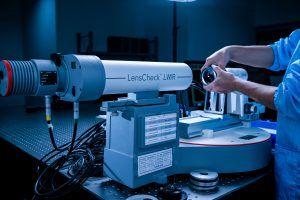
Ask your supplier specifically: "What is your MTF at -40°C and +80°C?" If they cannot provide this data, they may not have validated athermalization properly.
Bonus: Detector Compatibility
Even if the lens optical parameters are correct, mechanical compatibility with your detector matters. Key questions:
- What is the detector's pixel pitch? Lens MTF must exceed detector Nyquist frequency for useful image formation.
- Is there a standard window size and mounting interface, or is custom mechanical design required?
- Does the lens require a specific detector controller or can it work with your existing electronics?
Working with a lens supplier who has experience with your specific detector platform can save months of integration debugging.
Summary: Your Infrared Lens Supplier Evaluation Checklist
Before committing to a supplier, verify these five parameters with actual test data — not just datasheet specifications:
- Focal length and FOV — Request optical simulation or measurement data at operating temperature
- F-number — Confirm effective F-number with coatings applied, not theoretical clear aperture
- Spectral band — Match to your detector and application requirements
- Optical material — Evaluate cost vs. performance trade-off for your volume and environment
- Temperature range — Get MTF plots at temperature extremes, not just room temperature
WANBAO IR provides complete specification sheets, MTF test data at temperature extremes, and detector compatibility consultation for all LWIR, MWIR, and SWIR lens programs. Contact our technical team to begin your lens evaluation.
Related reading
- Infrared Lens Coatings: DLC vs Standard AR vs Hybrid for Harsh Environments
- Marine IR Lenses: Salt-Fog Resistant LWIR/MWIR Optics
Have a technical inquiry?
Our sales team responds within 24 hours with specifications, pricing, and technical consultation.
CONTACT US →