Introduction
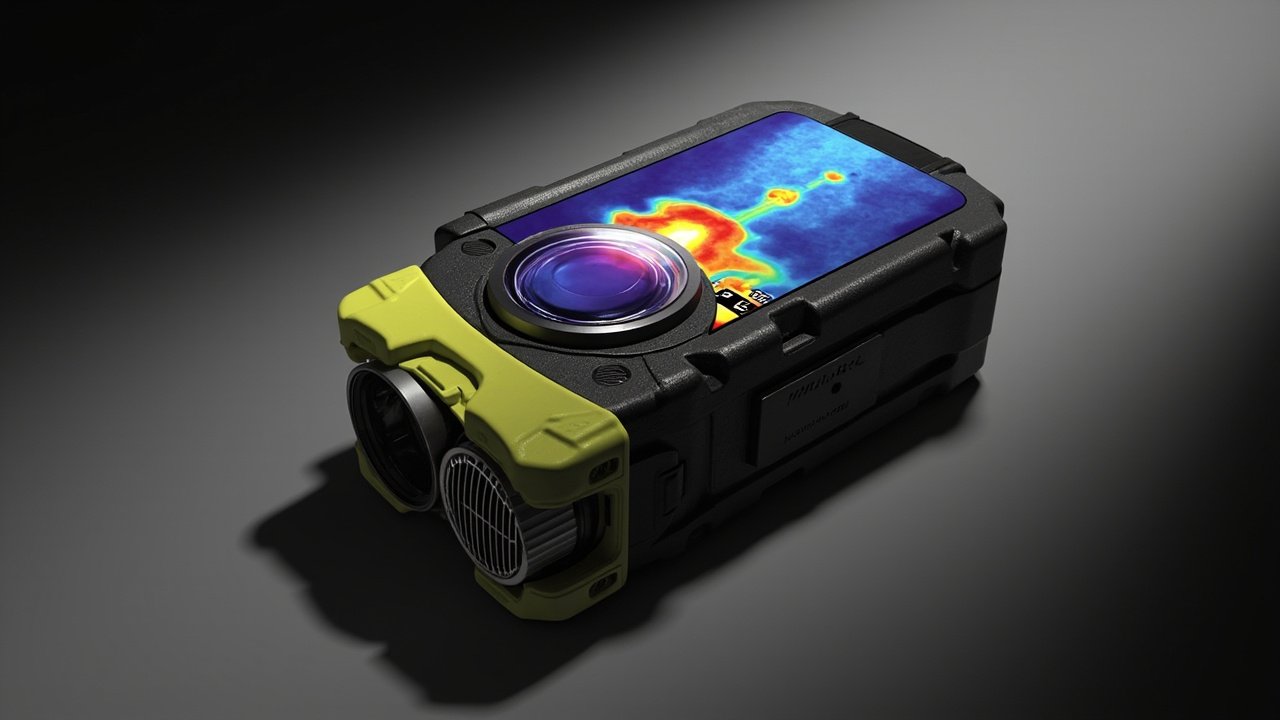
Firefighting operations confront environments where visible light fails catastrophically. Dense smoke reduces visibility to near-zero, structural collapse risks obscure conventional routes, and combustion byproducts create optical conditions that render the human eye ineffective. Thermal imaging has transitioned from auxiliary equipment to mission-critical technology, enabling firefighters to navigate obscured structures, locate heat sources, and identify victims through temperature differentiation.
The global market for firefighting thermal imaging cameras has experienced sustained growth driven by regulatory mandates and operational necessity. For original equipment manufacturers (OEMs) and system integrators, understanding the optical engineering constraints specific to this application determines product viability in certification testing and field deployment. This article examines the technical specifications, optical requirements, and lens engineering principles that define effective thermal imaging systems for firefighting operations, with practical guidance for procurement and system design.
Thermal Imaging Basics: LWIR and MWIR Spectral Bands
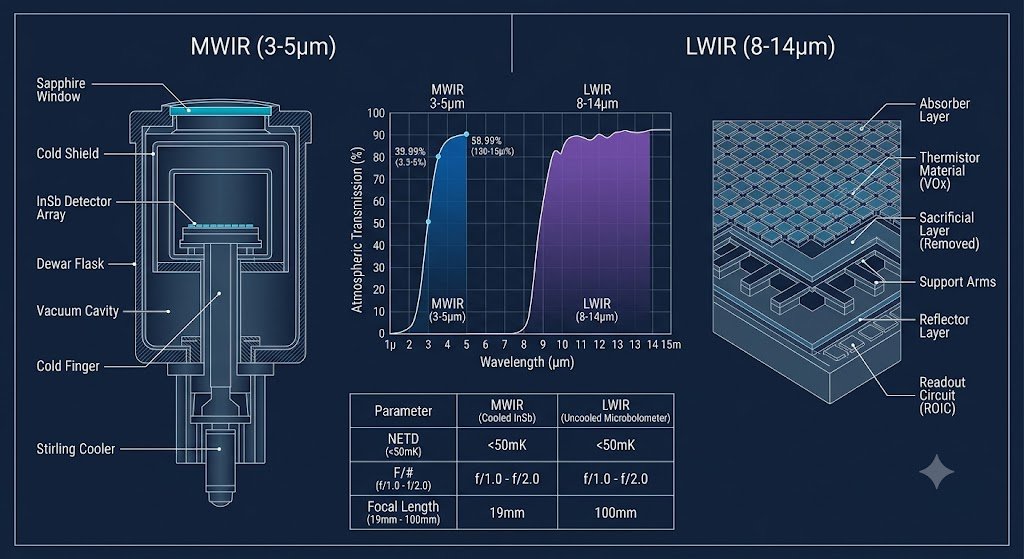
Thermal imaging operates in two primary atmospheric transmission windows: the Long-Wave Infrared (LWIR) band of 8–14 μm and the Mid-Wave Infrared (MWIR) band of 3–5 μm. These spectral regions correspond to blackbody radiation peaks for temperatures typical in firefighting scenarios.
LWIR (8–14 μm) dominates firefighting applications due to superior performance in smoke and particulate-laden atmospheres. Longer wavelengths reduce scattering sensitivity in aerosol environments; Rayleigh scattering decreases approximately with λ⁻⁴, while Mie scattering effects become less dominant when particle sizes are comparable to or smaller than wavelength scale. LWIR detectors are primarily uncooled microbolometers operating near ambient temperature, eliminating cryogenic cooling requirements and reducing system complexity and power consumption.
In practical system design, the LWIR band is often optimized to approximately 7.5–13.5 μm depending on detector response characteristics and atmospheric transmission behavior.
MWIR (3–5 μm) offers advantages in longer-range detection and higher-temperature measurement but typically requires cooled detector technology (Stirling-cycle or thermoelectric cooling). MWIR systems may require spectral management around the 4.2–4.5 μm CO₂ absorption band, which can introduce atmospheric attenuation in combustion-heavy environments. MWIR optics are therefore more commonly used in perimeter monitoring and aerial systems where path length and particulate density are reduced.
Key Optical Requirements for Firefighting
Firefighting thermal cameras must operate under extreme environmental constraints. The following requirements represent typical engineering targets rather than absolute physical limits:
- Environmental Sealing: IP67 or IP68 ingress protection is required. IP67 ensures dust-tight sealing and short-term water immersion resistance, while IP68 provides extended immersion protection depending on manufacturer specifications. Sealing must remain stable under repeated thermal cycling and exposure to firefighting agents.
- Operating Temperature Range: Typical system design targets range from -20°C to +85°C for electronics operation. Optical assemblies may be designed for short-term survivability beyond this range when properly shielded, but detector operation is not intended at extreme external temperatures.
- Explosion Protection: ATEX and IECEx certification may be required depending on deployment environment. Optical windows are typically implemented using thick germanium or zinc selenide elements selected based on spectral band and mechanical design requirements. Window design is driven by pressure containment and housing architecture rather than composite stacking materials.
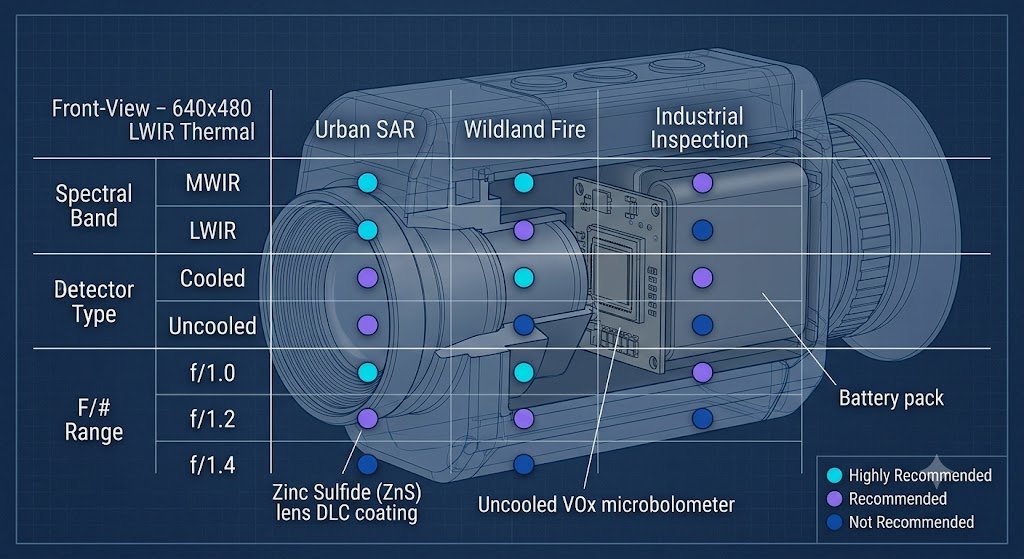
- Anti-Fog and Hydrophobic Coatings: Diamond-like carbon (DLC) and hydrophobic coatings are commonly applied to reduce surface contamination and water film formation. DLC coatings are typically controlled in sub-micron thickness ranges to balance mechanical durability and infrared transmission performance.
- Field of View: Wide field-of-view designs (approximately 50°–70°) are commonly used for navigation and situational awareness in interior firefighting scenarios, while narrower FOV systems are used for inspection and long-range detection.
Lens Selection for Firefighting Applications
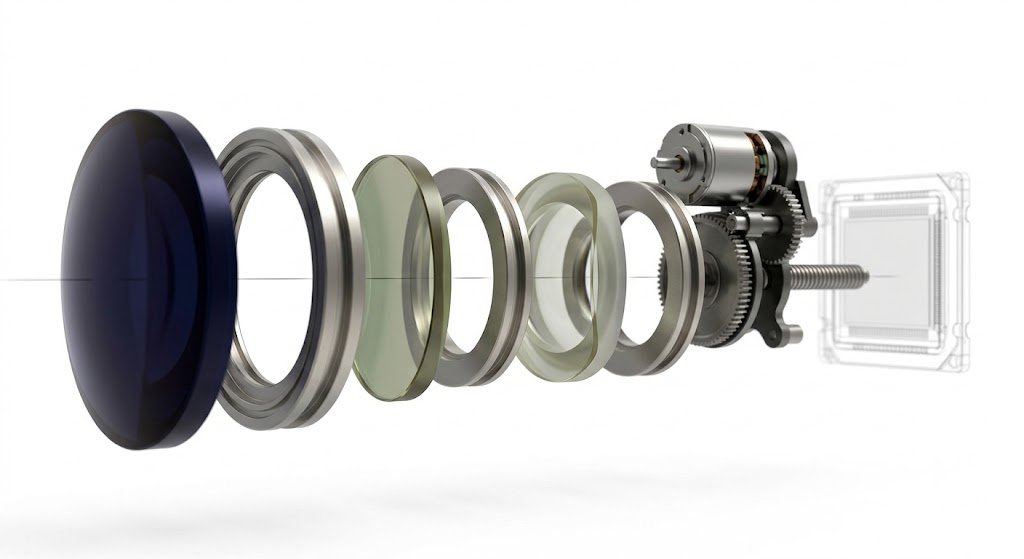
Germanium (Ge) Lenses
Germanium is widely used for LWIR optical systems due to its high transmission across the 8–12 μm band when properly anti-reflection coated. It exhibits a high refractive index (~4.0 at 10 μm), enabling compact optical designs.
However, germanium has a relatively high thermal refractive coefficient, which can introduce focus shift under temperature variation. Athermalization strategies typically include mechanical compensation using housing materials with controlled thermal expansion and, in some cases, active focus mechanisms.
Thermal mismatch between germanium and aluminum housings can induce mechanical stress; therefore, materials such as titanium alloys or Invar are sometimes used to improve thermal stability in precision optical assemblies.
Chalcogenide Glasses
Chalcogenide glasses (e.g., Ge-As-Se systems) offer improved thermal stability compared to germanium and can support passive athermalization across a broad temperature range. Their transmission in LWIR is typically lower than germanium but sufficient for many imaging applications.
These materials are commonly used in precision molded optics for cost-effective high-volume production, particularly where system-level thermal stability is critical.
Athermalization Engineering
| Approach | Method |
| Mechanical compensation | Differential thermal expansion between optical barrel and housing materials |
| Optical compensation | Combination of materials with opposing thermal optical power behavior |
| Active compensation | Motorized focus adjustment with temperature feedback |
Passive athermalization is generally preferred in firefighting systems due to reliability requirements under shock, vibration, and thermal stress.
Typical Optical Specifications
| Parameter | Specification |
| Relative aperture | f/1.2–f/1.4 (typical LWIR designs) |
| Focal length range | 8 mm to 50 mm depending on application |
| Example configuration | 13 mm f/1.2 lens on 640×480, 17 μm detector |
| Field of View | ~50°–60° typical for handheld systems |
| Detector compatibility | 640×480 or 1024×768 microbolometer arrays |
Application Scenarios
Structure Fire Attack
Interior firefighting requires real-time thermal imaging with sufficient frame rate and sensitivity to detect temperature gradients through smoke and debris. Wide field-of-view and low distortion are critical for navigation safety.
Search and Rescue
Human detection depends on temperature contrast between body and environment. High sensitivity detectors (<50 mK NETD typical target) improve detection probability in thermally complex environments.
Wildland Firefighting
Long-range thermal imaging systems are used for perimeter monitoring and hotspot detection. MWIR and LWIR systems are both used depending on atmospheric conditions.
Vehicle-Mounted Systems
Mounted systems require mechanical robustness, vibration resistance, and compliance with environmental and EMC standards such as MIL-STD-810 and MIL-STD-461.
Conclusion
LWIR uncooled systems are the dominant architecture for structural firefighting due to robustness, cost efficiency, and operational simplicity. MWIR systems remain relevant in specialized long-range and high-temperature measurement applications. Optical system design must balance transmission efficiency, thermal stability, and environmental survivability.
System integrators typically prioritize LWIR architectures combined with passive athermalized optics for new firefighting product development.
About Optical Manufacturing
WANBAO IR operates as an optical component manufacturer and integration specialist focused on infrared lens assembly, precision machining, and optical coating processes. The company sources raw optical substrates from qualified suppliers and focuses on downstream optical system integration and application-specific engineering.
Capabilities include germanium lens fabrication, chalcogenide molding, multi-element optical assembly, and coating technologies such as DLC and AR coatings. Support is provided for environmental and certification testing including IP67/68 and ATEX/IECEx coordination.
Related reading
- Uncooled FPA Detector Compatibility: How to Match Infrared Lenses with Major Thermal Sensor Brands
- Germanium Lens Manufacturer in China: How to Source High-Quality LWIR Optics Without the Premium Price Tag
Have a technical inquiry?
Our sales team responds within 24 hours with specifications, pricing, and technical consultation.
CONTACT US →