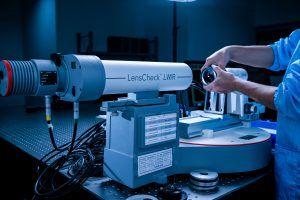

Cooled infrared detector optics selection for OEM thermal imaging requires matching 3-5μm lens transmittance to detector cut-off wavelength, optimizing F/# for NETD, and engineering dewar-to-lens thermal isolation to preserve field NETD over service life.
Cooled Infrared Detector Optics: How MWIR Differs from Uncooled Systems
Cooled MWIR detectors achieve sensitivity levels that uncooled microbolometers cannot match because cryogenic cooling suppresses detector dark current. A typical cooled infrared detector operating at 77K to 150K — and the cooled infrared detector optics that surround it — delivers NETD below 20 mK, while uncooled 3-5μm systems typically operate at 50-80 mK. This sensitivity advantage directly improves detection range and gas detection selectivity. Unlike uncooled lenses designed for F/1.0 or faster throughput, cooled MWIR optics usually operate between F/2.0 and F/4.0. They must interface with a cold stop inside the dewar, prevent stray reflections from returning to the detector, and avoid thermal emission from the lens barrel. The selection process starts with detector cut-off wavelength and cold stop geometry, not just detector pixel pitch. A common misconception is that cooled MWIR optics and uncooled LWIR optics are interchangeable. They are not. A cooled MWIR lens must match the detector cold shield aperture exactly; if the lens F/# is faster than the detector cold stop F/#, stray flux reaches the detector and destroys NETD. If slower, the system loses sensitivity unnecessarily. Uncooled lenses have no cold stop and tolerate a wider F/# range without degrading performance. Cooled MWIR optics also require careful narcissus control because any warm lens surface that reflects the cold detector creates a dark or bright spot in the image when ambient temperature changes. WANBAO IR reviews cold-stop position, dewar window material, and lens barrel temperature stability together with F/# to ensure optical path compatibility with the detector. This system-level view prevents the most common failure in cooled MWIR integration: pairing a low NETD detector with a lens that cannot maintain that NETD in the field.
MWIR Lens Material Selection: Germanium vs Silicon vs Sapphire Windows
Material selection for MWIR cooled optics is driven by the 3-5μm MWIR band, cryogenic environment, and system weight budget. Germanium is the most common MWIR lens material because it transmits from 2-14μm and has a high refractive index around 4.0. This high index allows strong optical power with fewer lens elements and helps reduce the physical length of a cooled lens assembly. Germanium is also dense, which increases weight, so thermal compensation may be needed in systems that operate over wide ambient temperature ranges. Silicon transmits from 1.2-7μm and is significantly lighter and lower cost than germanium. Silicon's lower refractive index around 3.4 requires more elements or deeper curves, but its visible alignment capability can simplify manufacturing and alignment for hybrid systems. Sapphire transmits from 0.2-5.5μm and offers extreme hardness and resistance to rain erosion, salt fog, and thermal shock. Sapphire is commonly used as a dewar window material because it can withstand thermal expansion mismatch between the cryogenic detector and the ambient environment while maintaining a strong vacuum seal. Do not select a material based only on transmission curves. In cooled MWIR systems, dewar window mechanical stability matters as much as lens element performance. WANBAO IR typically evaluates coefficient of thermal expansion, AR coating adhesion at cryogenic temperatures, and total system mass before recommending a material set.
| Material | Wavelength | Pros | Cons | Best for |
|---|---|---|---|---|
| Germanium (Ge) | 2-14μm | High refractive index, broadband LWIR | Opaque to visible, heavy | Long-range MWIR cooled |
| Silicon (Si) | 1.2-7μm | Low cost, visible alignment | Limited >7μm | MWIR only, hybrid systems |
| Sapphire (Al2O3) | 0.2-5.5μm | Extreme hardness, broadband visible-IR | Mid-range transmittance | Dewar window, harsh env |

F/# Optimization for Cooled MWIR Detector NETD
F/# is the single most consequential optical parameter for a cooled infrared detector. In a cryogenically cooled MWIR detector, the cold stop inside the dewar defines the optical aperture that the lens must match. Industry practice is to design the lens so that its image-side F/# equals the detector cold shield F/#, typically between F/2.0 and F/4.0. If the lens is faster than the cold stop, excess photons from warm baffles and barrel surfaces reach the detector and degrade NETD. If the lens is slower, the system loses sensitivity and may fail detection range requirements. The relationship between F/# and NETD is approximately quadratic: for an ideal photon-limited detector, halving the F/# improves sensitivity by up to a factor of four, but it also increases optical complexity and shallow depth of field. A lower F/# lens has a larger aperture for a given focal length, which gathers more signal. However, it also requires more elements to correct aberrations and may conflict with the dewar cold shield dimensions. Many OEM teams assume they should always specify the fastest lens possible. That is a mistake for cooled systems. The detector cold stop is fixed, and a lens faster than that stop adds cost, weight, and optical risk without improving NETD. In our experience, the better approach is to start with the detector's cold shield F/# and back working distance, then optimize modulation transfer function and distortion within that constraint. For industrial gas detection, F/2.0 to F/4.0 lenses typically provide the sensitivity and depth of field needed to image gas plumes while maintaining calibration stability. For long-range thermal monitoring, F/2.5 to F/4.0 is common because narrower fields of view prioritize magnification and atmospheric transmission. Scientific spectroscopy often uses F/2.0 to F/3.0 because spectral measurements require high signal-to-noise ratio. Beyond F/#, back working distance is critical. Cooled MWIR detectors often have a dewar window and cold stop that extend 15 mm to 30 mm from the detector focal plane. The lens must deliver the prescribed image-side F/# at that cold stop distance. If the back working distance is too short, the lens may physically interfere with the dewar. If it is too long, the lens may require additional elements to maintain F/# and image quality. WANBAO IR supports this calculation as part of MWIR lens evaluation, using the detector cold stop rather than the lens barrel as the reference aperture.

Dewar-to-Optics Integration: Thermal Isolation Engineering
Dewar-to-optics integration starts with the cold finger. The cold finger is the thermal link between the detector and the cooler. Its length and stiffness determine how well the detector remains at cryogenic temperature despite ambient thermal loads. If the cold finger is too short or poorly isolated, heat leaks raise detector temperature and increase dark current. The lens must not contact the dewar body in a way that conducts additional heat. Instead, the dewar window should be part of the vacuum envelope and mechanically decoupled from the lens barrel. AR coating durability at cryogenic temperatures is another common failure point. Coatings that perform well at room temperature can delaminate when cooled to 77K and exposed to Stirling or Joule-Thomson cooler vibration. For MWIR cooled systems, we recommend specifying cryogenic AR coating validation from the optics supplier, including thermal shock and vibration testing. Sapphire window seals must also be matched to the coefficient of thermal expansion of the dewar flange. A mismatched seal can fail after repeated cool-down cycles, breaking vacuum and destroying detector performance. Thermal isolation efficiency is sometimes quantified as the temperature delta between the detector cold finger and the dewar outer body under steady-state operation. An industry standard cooled MWIR detector should maintain the focal plane at its designed operating temperature with less than a few kelvins of added thermal load from the lens mount. We evaluate this by reviewing the detector cooler margin, the dewar window thermal conductivity, and the lens barrel material emissivity.

Cooled Infrared Detector Optics: Application Decision Matrix + 5 Red Flags
Selecting an MWIR cooled lens is not a one-size-fits-all process. The table below summarizes typical application requirements for F/#, lens material, dewar window selection, and NETD target. These values represent industry standard starting points based on typical OEM procurement data and the 3-5μm MWIR band. Actual specifications depend on detector cold stop geometry, field of view, and environmental conditions.
| Application | Recommended F/# | Lens Material | Dewar Window | NETD Target |
|---|---|---|---|---|
| Industrial gas detection | f/2.0-f/4.0 | Ge | Sapphire | <25 mK |
| Long-range security monitoring | f/2.5-f/4.0 | Ge | Sapphire | <20 mK |
| Scientific spectroscopy | f/2.0-f/3.0 | Si or Ge | Custom AR | <15 mK |
| Maritime monitoring | f/2.5-f/4.0 | Ge | Sapphire (salt-fog) | <25 mK |
5 Red Flags to Avoid:
- 🚩 Lens vendor does not specify cryogenic AR coating durability
- 🚩 No data on dewar-to-lens thermal isolation efficiency
- 🚩 Generic "MWIR compatible" claim without specific wavelength cut-off
- 🚩 F/# quoted without detector cold-stop distance
- 🚩 No field-deployment references in industrial or long-range monitoring applications
Each application has a different balance of sensitivity, depth of field, and environmental survival. Industrial gas detection often needs a wide field of view and stable NETD because gas plume detection relies on differential absorption against a moving background. Long-range security monitoring prioritizes magnification and atmospheric transmission. Maritime monitoring requires sapphire windows that withstand salt fog and high-velocity rain while maintaining a reliable vacuum seal. In all cases, the lens must be specified alongside the detector dewar, not after purchase. WANBAO IR recommends asking for a dewar interface drawing and a test report covering thermal cycling, AR coating adhesion, and F/# match before committing to production. Requesting cryogenic validation data early is the single most effective way to separate a true cooled MWIR optics supplier from a catalog lens reseller.

Conclusion: MWIR Cooled Optics as a System-Level Decision
MWIR cooled detector optics are a system-level decision, not a standalone lens specification. The best F/# and MTF values do not matter if the dewar-to-optics thermal isolation fails after 12 months. Field NETD degradation of 30-50% is a real failure mode when cold finger length, AR coating durability, or sapphire window seal integrity are ignored. This is why WANBAO IR evaluates cooled infrared detector optics from the detector cold stop outward, not from a standard lens catalog inward. A robust MWIR cooled lens specification includes detector cut-off wavelength, image-side F/# matched to the cold shield, back working distance to the dewar window, cryogenic AR coating validation, and a thermal isolation plan. Materials such as germanium, silicon, and sapphire each have specific roles: germanium for compact high-power elements, silicon for visible alignment and MWIR-only systems, and sapphire for dewar windows in harsh environments. The application decision matrix in this guide provides a starting point, but every integration should be refined using the detector dewar drawing and the cooler's thermal budget. Field performance should be modeled over the full service life, not just at first installation.
Ready to specify MWIR optics for your cooled detector OEM integration? Contact WANBAO IR for lens engineering consultation, dewar integration support, and cryogenic AR coating validation.
Related Articles
- Infrared Lens Engineering Guide: LWIR, MWIR, SWIR Optics
- Uncooled FPA Detector Compatibility: How to Match Infrared Lenses
- Maritime Thermal Imaging Optics: Salt-Fog Resistant LWIR/MWIR Lenses
- Athermalized LWIR Lenses: Why Thermal Stability Matters
- Chalcogenide Glass vs Germanium Infrared Lenses: LWIR Optics Material Comparison
About Sichuan Wanbaohui Technology Co., Ltd. (WANBAO IR)
Sichuan Wanbaohui Technology Co., Ltd. (WANBAO IR) is a professional supplier and exporter of precision infrared optical components for thermal imaging, long-range defense monitoring, industrial gas detection, and scientific sensing OEM applications. We manufacture MWIR cooled and uncooled optics, germanium and silicon lenses, sapphire dewar windows, and custom AR-coated assemblies in collaboration with qualified manufacturing partners.
Our engineering team supports OEM customers with F/# optimization, dewar-to-optics thermal isolation design, cryogenic AR coating validation, and wavelength-matched lens selection for cooled InSb, MCT, and InGaAs detectors across 1-14μm bands.
Email: sales@wanbaoir.com | Website: https://wanbaoir.com
Related reading
- MWIR Lens for Gas Leak Detection: A Complete Guide for OGI System Integrators
- Germanium Window Engineering Guide: LWIR 8-14μm Optical Material Selection for Industrial Thermal Imaging
Have a technical inquiry?
Our sales team responds within 24 hours with specifications, pricing, and technical consultation.
CONTACT US →